

Archive for the ‘Kung Fu Kickboxing MMA’ Category
Nepal’s kung fu nuns practice karma with a kick
Wednesday, May 9th, 2012
It is a hot, cloudless morning on a hillside on the outskirts of Kathmandu and dozens of nuns arrange themselves into lines around a golden Buddhist shrine.
In unison, each slams a clenched fist into their opposite palm, breathes deeply and waits, motionless in the rising heat.
But these devotees are not here to pray or to meditate, for they have gathered to undergo a rigorous and aggressive martial arts routine as the world’s first order of kung fu nuns.
The sisters of the Amitabha Drukpa Nunnery — aged from nine to 52 — come from across Nepal, India, Tibet and Bhutan to learn the ancient Chinese discipline of kung fu, which they believe will help them be better Buddhists. Every day, they exchange their maroon robes and philosophical studies for a intense 90-minute session of hand chops, punches, shrieks and soaring high kicks.
“The main reason for practising kung fu is for fitness and for health, but it also helps with meditation and self-defence,” 14-year-old Jigme Wangchuk Lhamo, who was sent to the nunnery from Bhutan four years ago, told AFP. ”When we practise kung fu we are doing something which gives us not only strong bodies but also strong minds.”
Buddhist nuns in the Himalayas have traditionally been seen as inferior to monks, with the women kept away from physically demanding exercise and relegated to menial tasks like cooking and cleaning. But the 800-year-old Drukpa — or dragon — sect is changing all that by mixing meditation with martial arts as a means of empowering its women. The nuns, in contrast to most Buddhist groups, are also taught to lead prayers and given basic business skills, as well as running a guest house and coffee shop at the abbey and driving jeeps to Kathmandu to get supplies.
Kung fu came to the nunnery only four years ago when its spiritual leader, His Holiness the 12th Gyalwang Drukpa, visited Vietnam, where he saw nuns receiving combat training that was previously used by Viet Cong guerrillas. He was so impressed that he brought four of the Vietnamese, all women in their 20s, to Nepal to add kung fu lessons to the nuns’ yoga classes and lessons in the nuances of good and bad karma.
“Our nuns… are very new to modernisation and are timid and lack self-confidence,” the Gyalwang Drukpa wrote in a recent blog post. ”I am not saying that I am a great teacher or a great leader but the path that I have decided to take in order to promote gender equality, so as to bring about the nuns’ improvement, gives me great encouragement to work harder and live longer.”
Jigme Konchok Lhamo, 18, who came to the order from India, says kung fu has quickly made the nuns more assured and has begun to address the power balance between men and women in Buddhism. ”His Holiness wants the nuns to be like the men, with the same rights in the world,” she said. “That is why we get the chance to do everything, not just kung fu. ”We also have the chance here to learn many things, like tennis and skating. And we have the chance also to learn English and Tibetan, and musical instruments.
“In the past only men could do some of the dances. Now we have the chance to take part. Before nuns could not do anything and now we have the chance to do anything the monks can do.”
The nunnery is enjoying a surge in popularity since introducing the kung fu lessons and now has some 300 nuns practicing martial arts techniques. They have given demonstrations of their skills to thousands of pilgrims in Nepal and have toured India and Britain. The nuns say the repetitive nature of Shaolin kung fu, which comes from the Buddhist temple of Shaolin in China’s Henan province, helps them to learn control and focus.
The benefits are obvious for young women who are expected to meditate in the same position for up to six hours at a time and sometimes undertake retreats during which they must remain silent for months.
Jigme Migyur Palmo, a soft-spoken 21-year-old nun, who came to Kathmandu three years ago from her home in Ladakh, in northern India, said kung fu works in harmony with her spiritual life. She watched Jackie Chan kung fu movies when she was younger and now wants to be as good as the Hong Kong film star.
“I came to Kathmandu to learn Buddhist philosophy and now I don’t want to go home, I want to stay here my whole life,” she said.
Read the original post: here.
Professional Titles in Martial Arts
Monday, April 23rd, 2012
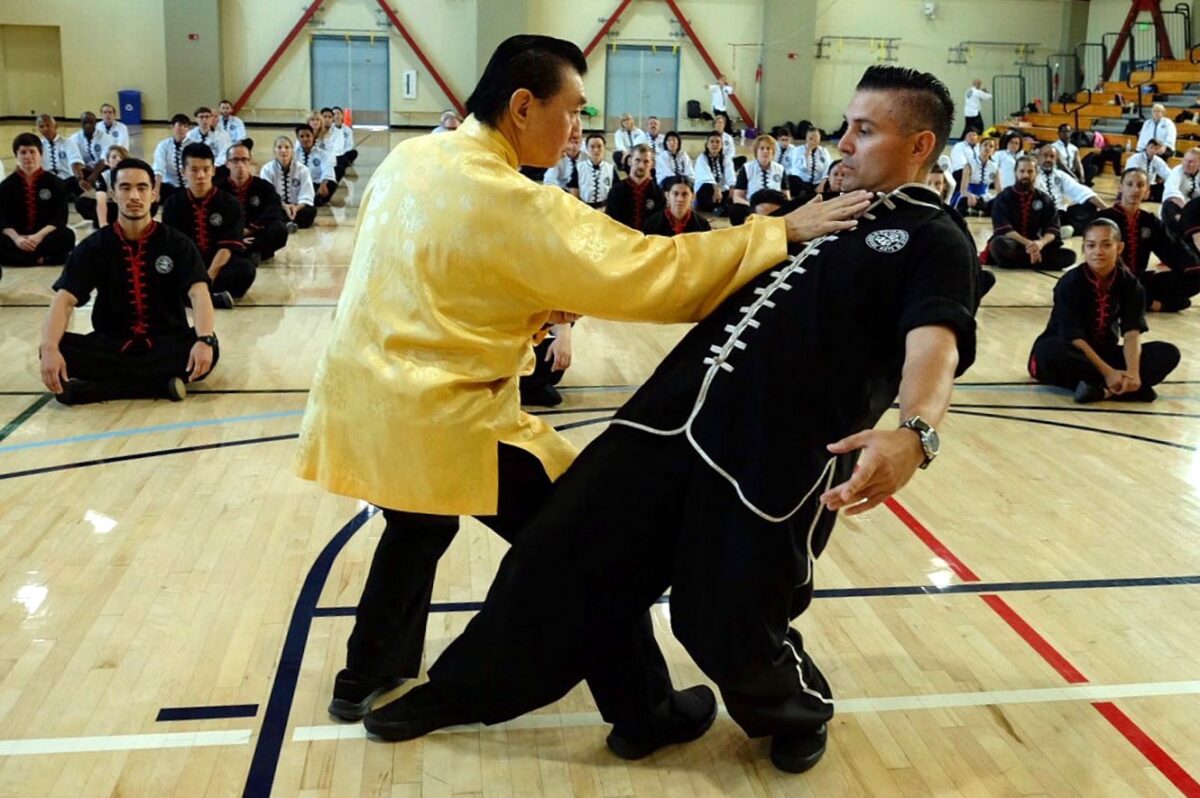
Many martial arts instructors these days adopt professional titles, such as master or grandmaster, to improve their credibility or solely to impress their students. Some even invent titles to make themselves appear more accomplished than their competition, or even their own teachers.
However, legitimate martial arts titles have nothing to do with self-promotion. Instead, such titles should the result of a lifetime spent promoting your system and students.
In China, all martial art instructors are called sifu or shifu in Mandarin. Some Northern Chinese call their teacher by the term laoshi or losi in Cantonese. Many third-generation students call their teacher’s teacher si-gung or tai-laoshi. The fourth-generation students often refer to the first-generation teacher as tai-sigung or si tai gung.
However, there are not many traditional kung-fu teachers in China with more than four generations of students below them, because a teacher’s students usually have to help teach until the teacher dies. Then the students can begin to teach on their own. In some cases, when highly skilled students move far from their teacher, they are permitted to teach on their own before their teacher’s death. In this case, it is easy to see how a third generation of students can come about. However, a third-generation instructor could only happen if this person’s student were also to move far away and begin teaching on his own.
For a rare fourth-generation instructor to be produced, this process would have to happen yet again. So as you can see, to arrive at four generations of instructors all living and teaching the same art, at the same time, is quite rare.
All the titles for addressing students and teachers are based on Chinese family titles. For example, sifu means teaching father. The wife of the teacher is called si-mo, even though she usually has no knowledge of her husband’s martial art. If the teacher is a woman, she is still referred to by the masculine term sifu. The lady sifu’s husband is called si-jeong or teaching uncle, even though he may not practice martial arts.
The term for a male senior classmate is si-hing or shi-xiong in Mandarin. A female senior classmate is called si-jie, or in Mandarin shi-jie. A male junior classmate is called si-daih or shi-di, whereas a female junior classmate is called si-moi or shi-mei. Your teacher’s male or female senior classmate is called si-bak or shi-buo. And similarly, your teacher’s male or female junior classmate is called si-suk or shi-shu.
These titles have little to do with formal ranking or learning levels; they are used in China mostly as a way of politely addressing people you would normally see in and around your teacher’s school. So, how did we arrive at the complicated ranking systems and titles used in today’s martial arts schools?
When American GIs imported Japanese and Korean martial arts into North Amercia after the World War II, many of the early teachers began to devise more-extensive ranking systems. The karatedo and tae kwan do organizations in the U.S. and Europe were some of the first schools that used colored belts, degrees and professional titles for ranking purposes. In those organizations, a fifth-degree black belt who taught was qualified to be a master. The ninth- or tenth-degree black belt who headed the organization was usually considered to be a grandmaster.
Yet, despite all these precedents and traditions, there is no shortage of individuals willing to bestow all manner of exotic titles on themselves. I can understand the kung-fu instructor who uses the “grandmaster” title after developing a sizeable organization, which includes several qualified master and sifu-level instructors.
There are some instructors that have never produced a single master- or sifu-level student, but see nothing wrong with using the title of grandmaster. Some of the so-called grandmasters don’t even have many students, let alone a full-time school. Some assume this title just because they have produced a student who is an instructor. Perhaps they confuse the title of grandmaster with grandfather. Yet, as I explained earlier, these titles are not the same.
In my case, my teachers certified me grandmaster so I could pass on their particular systems of martial arts. Today, my Plum Blossom International Federation has over 100 schools worldwide and I have produced more than one master-level instructor and dozens of sifu-level instructors encompassing five generations of teachers.
In my Federation, we only award professional titles such as sifu or master to instructors actively involved with teaching in their own school or organization. A certified staff instructor in one of our schools must be at least an advanced-level or black sash-level student. To earn the title of sifu, one must complete the senior advanced level and must be the head instructor of a full-time school. The master level is reserved for someone who has not only completed the senior-advanced level, but also has produced a couple of sifu-level instructors that run schools.
A grandmaster is promoted by the soon-to-be-retired senior grandmaster, after this individual has produced a couple of master-level instructors. These master-level instructors and sifu are the foundation of a martial arts organization of significant size that promotes a particular system on a full-time basis.
As you can see, the true master or grandmaster is not self-appointed. Holding the title of master or grandmaster carries a significant level of responsibility and represents a lifetime of effort spent building a great martial arts organization. The true grandmaster achieves his title by producing many successful masters and sifu that are hard at work teaching their art to the next generation.
Exercise Can Actually Make You Smarter
Monday, March 26th, 2012Your brain can shrink up to 15 percent as you get older, and this size decrease is associated with dementia, poor memory and other mental health issues like depression. But this shrinkage isn’t inevitable. People with “healthy” brains are less likely to experience this loss in brain size, even if they’re older. What’s one of the most important steps you can “take” to keep your brain healthy? Exercise!
Want to Get Smarter? Do This Often…
If you value your brainpower, you’ll want to make certain that exercise is a regular part of your life.
Staying active with a variety of activities is best, as each type of exercise may offer unique benefits for your brain health and may even help your brain to grow as you get older, rather than shrink.
For instance, a review of more than 100 studies, published in the Journal of Applied Physiology, revealed that both aerobic and resistance training are important for maintaining cognitive and brain health in old age.
The lead researcher, Michelle Voss, assistant professor of psychology at the University of Iowa, noted multiple benefits of each.
As reported in the Los Angeles Times:
“Aerobic exercise improves ability to coordinate multiple things, long-term planning and your ability to stay on task for extended periods. Resistance training, which is much less studied than the aerobic side of things, “improves your ability to focus amid distracters.”
… Voss explained that MRIs of people in their 60s showed increases in gray and white matter after just six months of exercise. This happens in the prefrontal and temporal lobes, sites that usually diminish with age. With exercise, Voss says, they grow.
Voss also explained that the hippocampus area of the brain, key for memory formation, shrinks 1% to 2% per year in those older than 60, but when people in this age group begin fitness regimens, it grows by 1% to 2% instead. Beyond growing one’s brain, exercise improves the ability of different parts of the brain to work together, Voss says.”
Do You Want to Avoid Alzheimer’s Disease?
According to one of the studies referenced above, moderate exercise can reverse normal brain shrinkage by 2 percent, effectively reversing age-related hippocampus degeneration by one to two years.2 Also according to the study, the people in the control group who didn’t exercise saw an average of 1.4 percent decrease in hippocampus size.
Now listen up … when these researchers say the hippocampus region of the brain increases in size as a response to exercise, they are talking about a powerful tool to fight the onset of Alzheimer’s disease. The hippocampus, which is considered the memory center of your brain, is the first region of your brain to suffer shrinkage and impairment at the onset of Alzheimer’s disease, leading to memory problems and disorientation.
According to the research team:
“We demonstrate that loss of hippocampal volume in late adulthood is not inevitable and can be reversed with moderate-intensity exercise.”
Other contributing factors to brain disease caused by the normal aging process may also include a decrease in blood flow to your brain, and the accumulation of environmental toxins in your brain. Exercise can help ameliorate both of these conditions by increasing blood flow to your brain, thereby increasing oxygen supply to your brain and encouraging a more vigorous release and removal of accumulated toxins through better blood circulation. Increased blood flow may also promote delivery of more of the nutrients necessary to keep your brain cells healthy in the first place.
This is Your Brain “on Exercise”
Exercise encourages your brain to work at optimum capacity by causing nerve cells to multiply, strengthening their interconnections and protecting them from damage. Animal tests have illustrated that during exercise their nerve cells release proteins known as neurotrophic factors. One in particular, called brain-derived neurotrophic factor (BDNF), triggers numerous other chemicals that promote neural health, and has a direct benefit on brain functions, including learning. Further, exercise provides protective effects to your brain through:
- The production of nerve-protecting compounds
- Greater blood flow to your brain
- Improved development and survival of neurons
- Decreased risk of cardiovascular diseases
A 2010 study on primates published in the journal Neuroscience also revealed that regular exercise not only improved blood flow to the brain, but also helped the monkeys learn new tasks twice as quickly as non-exercising monkeys — a benefit the researchers believe would hold true for people as well.
Exercise Important for Kids’ Brains Too
Many people don’t think about their brain function until they start to lose it, i.e. when they begin to feel the hands of time start ticking away. But that is not to say that only those who are in their golden years can benefit. An extensive review of 14 studies, ranging in size from as few as 50 participants to as many as 12,000, demonstrated that the more physically active schoolchildren are, the better they do academically.
One test program not too far from our Chicago-area office at Naperville Central High School in Illinois illustrated this point in a powerful way two years ago. Students participated in a dynamic morning exercise program at the beginning of the day, and had access to exercise bikes and balls throughout the day in their classrooms. The results were astounding. Those who participated nearly doubled their reading scores, and their math scores increased 20-fold!
Research has also shown that after 30 minutes on the treadmill, students solve problems up to 10 percent more effectively. So it’s important that you encourage your child to stay active after school and on weekends in order to reap the wonderful brain-boosting benefits that exercise has to offer. Even better, be a positive role model and stay active together as a family.
Read the original post: here.
Major Secret in Relieving Joint Pain
Monday, March 19th, 2012Joint pain is incredibly common, impacting an estimated 30 percent of U.S. adults and causing pain, swelling and stiffness that can range from mildly irritating to completely debilitating.
While knee pain is the most common joint pain reported, shoulder, finger and hip pain are also common, and may occur from numerous causes such as osteoarthritis, injury, repetitive movement or strain on the joint, and poor posture.
Aging is another factor, as with age, the flexible tissues in your body tend to lose their elasticity, leading to sagging and wrinkling of skin, stiff muscles and painful joints.
This process may be exacerbated by inactivity, which promotes muscle weakness, joint contractures, and loss of range of motion.
This, in turn, can lead to more pain and loss of function, and even less activity.
Many people are under the impression that exercise is somehow dangerous for their joints, and joint pain is a condition that requires rest to recover … in reality, the opposite is true – exercise is essential for healthy joints and may even help to improve joint pain and function.
If You Have Joint Pain, Exercise is a Must
The notion that exercise is detrimental to your joints is a misconception, as there is no evidence to support this belief. Instead, the evidence points to exercise having a positive impact on joint tissues — if you exercise sufficiently to lose weight, or maintain an ideal weight, you can in fact reduce your risk of developing joint pain due to osteoarthritis rather than increase your risk. Exercise can also improve bone density and joint function, which can help prevent and alleviate osteoarthritis (a major cause of joint pain) as you age.
As noted by Harvard Health Publications:
” … limiting your movements can weaken muscles, compounding joint trouble, and affect your posture, setting off a cascade of further problems. And while pain relievers and cold or hot packs may offer quick relief, fixes like these are merely temporary.
By contrast, the right set of exercises can be a long-lasting way to tame ankle, knee, hip, or shoulder pain. Practiced regularly, joint pain relief workouts might permit you to postpone—or even avoid—surgery on a problem joint that has been worsening for years by strengthening key supportive muscles and restoring flexibility.”
Case in point, research shows that people with rheumatoid arthritis, which causes joint pain, stiffness and deformities, who did weight training for 24 weeks improved their function by up to 30 percent and their strength by 120 percent. Unfortunately, many with joint pain are missing out on these potential benefits. Research from Northwestern University Feinberg School of Medicine found that over 40 percent of men and 56 percent of women with knee osteoarthritis were inactive, which means they did not engage in even one 10-minute period of moderate-to-vigorous activity all week.
Exercise Can Also Help Your Joints via Weight Loss
Arthritis rates are more than twice as high in obese people as those who are normal weight, because the extra weight puts more pressure on your joints, as well as increases inflammation in your body. This can not only lead to osteoarthritis, it can also make joint pain from any cause exponentially worse.
Exercise, along with a healthy diet, can help you to jumpstart weight loss if you’re overweight, and this can lead to tremendous improvements in your joint pain. Harvard Health Publications states:
“Each pound you lose reduces knee pressure in every step you take. One study found that the risk of developing osteoarthritis dropped 50% with each 11-pound weight loss among younger obese women. If older men lost enough weight to shift from an obese classification to just overweight — that is, from a body mass index (BMI) of 30 or higher down to one that fell between 25 and 29.9 — the researchers estimated knee osteoarthritis would decrease by a fifth. For older women, that shift would cut knee osteoarthritis by a third.”
Read the original post: here.
The Seven Laws of Leanness
Friday, March 9th, 2012Why do some people seem naturally thin—able to torch cheeseburgers instantly and never gain a pound? And why do some of us—okay, most of us—sweat and diet and sweat and diet some more, and never lose enough to get the body we want?
Because those “naturally thin” people actually live by a series of laws that keep them from ever gaining weight. And if you know their secrets, you can indulge and enjoy and never gain another pound as long as you live.
As the editor-in-chief of Men’s Health, I’ve spent the past two decades interviewing leading experts, poring over groundbreaking studies, and grilling top athletes, trainers, and celebrities for their health and fitness advice. And I’ve learned that what separates the fit from the fat, the slim from the sloppy, the toned from the torpid, is a set of rules. And what’s amazing is that none of them involves spending hours on a treadmill, eating nothing but grapefruit and tree bark, or having part of the small intestine replaced with fiberfill. Follow these simple rules and weight loss will be automatic.
LAW #1: Lean People Don’t Diet

What? Of course lean people diet! They’re just magically better at denying themselves than the rest of us are, right?
No. In reality, studies show that the number one predictor of future weight gain is being on a diet right now. Part of the reason is that restricting calories reduces strength, bone density, and muscle mass—and muscle is your body’s number-one calorie burner. So by dieting, you’re actually setting yourself up to gain more weight than ever. And a recent study in the journal Psychosomatic Medicine showed that tracking your diet in a food journal can actually boost your stress levels, which in turn increases your level of a hormone called cortisol, and cortisol is linked to—you guessed it—weight gain.
FAT-FIGHTING FIBER: Get 25 grams of fiber a day—the amount in about 3 servings of fruits and vegetables—and you can boost fat burn up to 30 percent.
LAW #2: Lean People Don’t Go Fat-Free
A European study tracked nearly 90,000 people for several years and discovered that participants who tried to eat “low fat” had the same risk of being overweight as those who ate whatever they wanted.
Fat doesn’t make you fat, period. Indeed, you need fat in your diet to help you process certain nutrients, like vitamins A, D, and E, for example. And many “fat-free” foods are loaded with sugar, and therefore have even more calories than their full-fat cousins. Even the American Heart Association says that fat-free labels lead to higher consumption of unhealthy sweets. Fat keeps you full and satisfied. Fat-free will send you running back to the fridge in an hour, hungry for more.
LAW #3: Lean People Sit Down to Eat
In fact, the more you sit down and enjoy your food, the leaner you’re going to be. Punishing yourself only makes you fat!
Greek researchers recently reported that eating more slowly and savoring your meal can boost levels of two hormones that make you feel fuller. And researchers at Cornell University found that when people sat down at the table with already full plates of food, they consumed up to 35 percent less than they did when eating family-style—that is, by passing serving dishes around the table.
LAW #4: Lean People Know What They’re Going to Eat Next
Planning your responses to hunger may help you shed pounds faster, say Dutch researchers. They posed their subjects questions like “If you’re hungry at 4 p.m., then . . . what?” Those who had an answer (“I’ll snack on some almonds”) were more successful at losing weight than those who didn’t have an answer.
LAW #5: Lean People Eat Protein
In a recent European study, people who ate moderately high levels of protein were twice as likely to lose weight and keep it off as those who didn’t eat much protein.
A New England Journal of Medicine study looked at a variety of eating plans and discovered that eating a diet high in protein and low in refined starches (like white bread) was the most effective for weight loss. Protein works on two levels: First, you burn more calories to digest it. Second, because your body has to work harder to digest a Big Mac than, say, a Ho Ho, you stay fuller longer.
LAW #6: Lean People Move Around
I don’t mean climbing Kilimanjaro, breaking the tape at the Boston Marathon, or spending 24 hours at 24 Hour Fitness. I mean going for a short bike ride (20 minutes burns 200 calories), taking a leisurely walk (145 calories every 51 minutes), wrestling with your kids (another 100 calories smoked in 22 minutes), or fishing (there’s 150 calories gone in an hour—even more if you actually catch something).
Simply put, fit people stay fit by having fun. Scientists have a name for how you burn calories just enjoying yourself. It’s called NEAT: non-exercise activity thermogenesis. Sounds complicated, like something only policy wonks at a global warming summit are qualified to discuss. But it’s pretty simple: Pick a few activities that you enjoy, from tossing a stick for your dog to bowling with your best friend, and just do them more often. The average person makes 200 decisions every day that affect his or her weight. If you choose the fun option more often than not, you’ll see results.
LAW #7: Lean People Watch Less TV
Instead of calling it the boob tube, maybe we should call it the man-boob tube. About 18 percent of people who watch less than two hours of TV a day have a body mass index (BMI) of 30 or more—the cutoff line for obesity, according to the Centers for Disease Control and Prevention. But of those who watch more than four hours of TV a day, nearly 30 percent have a BMI that high, according to a study in the Journal of the American College of Cardiology.
Look, I like TV. But all things in moderation: In a study at the University of Vermont, overweight participants who cut their daily TV time in half (from an average of 5 hours to 2.5 hours) burned an extra 119 calories a day. And a recent study of people who successfully lost weight found that 63 percent of them watched less than 10 hours of TV a week. Want more? A study in the journal Annals of Behavioral Medicine reported that lean people have an average of 2.6 television sets in their homes. Overweight people have an average of 3.4. Finally, researchers in Australia recently discovered that every hour in front of the television trims 22 minutes from your life. Yikes!
Breaking any of these seven laws occasionally is fine. Just don’t make a habit of it.
Read the original post: here.