
The White Dragon School Blog
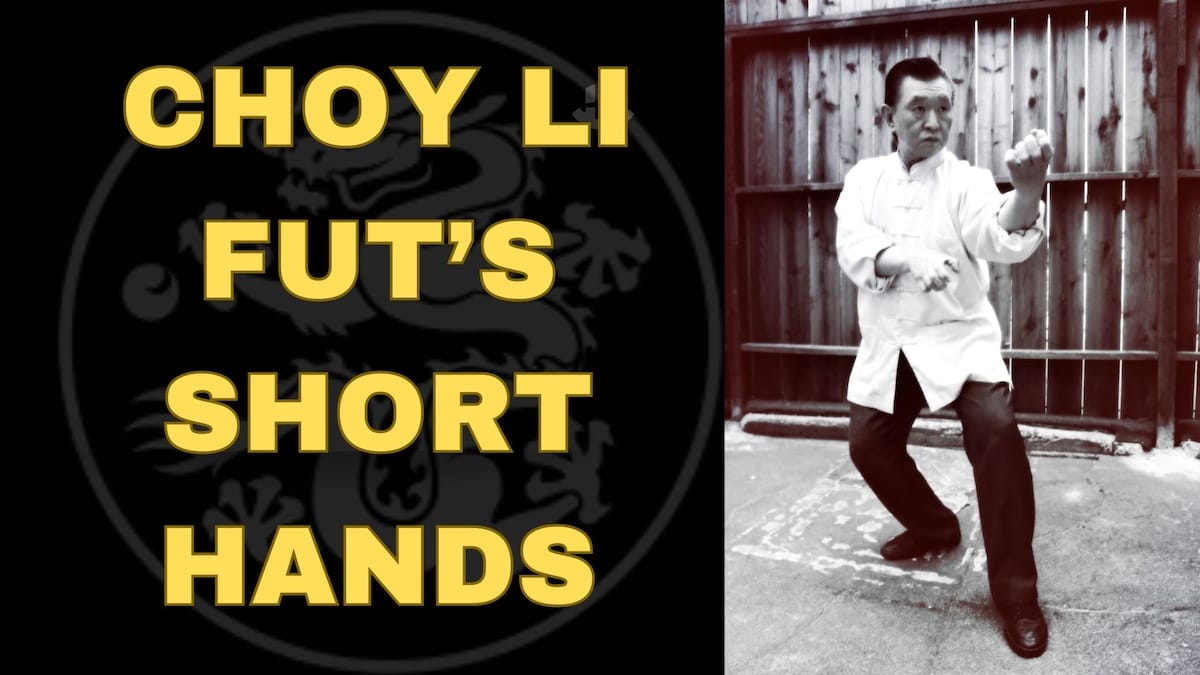
Choy Li Fut’s Short Hands
This Training for Life column was written by Grandmaster Doc Fai Wong, and published in the March 1995 issue of Inside Kung Fu Magazine.
Most people know of Choy Li Fut as a long-hand fighting system, having never heard about its short-hand, close-range techniques. The reason for this is that the most popular Choy Li Fut branch, Fut San, named after the province in China where it was originally taught, emphasizes mainly long-arm movements.
Another Choy Li Fut branch is Kong Chow, also named for the district where it was taught. Kong chow is not well-known nowadays, because it was handed down from Choy Li Fut’s founder Chan Heung’s oldest son, Chan On-Pak. Chan On-Pak died young and had few students.
Chan On-Pak, as the oldest son, is the second patriarch of Choy Li Fut.
I am one of only a few representatives of this lineage now. My third Choy Li Fut teacher, grandmaster Wong Gong, passed it down from his second teacher Chan Yen, who besides studying from his father Chan Kau had the opportunity to learn directly from Chan On-Pak. Chan On-Pak was the chief Choy Li Fut instructor in Kong Chow province, the district where Choy Li Fut originated.
I do have the benefit of the three major Choy Ii fut branches.
My Fut San training came from grandmaster Lau Bun in San Francisco, my first Choy Li Fut teacher. King Mui, another popular Choy Li Fut branch, came from my second teacher, Professor Hu Yuen-Chou.
King mui training is handed down from Chan Yiu-Chi, grandson of the founder.
Most people are familiar with common Choy Li Fut movements, such as kum na, sow, kwa and tsop. They can identify sow (roundhouse or swing punch), kwa (backfist), and tsop (straight punch), but not many can explain kum na—the shorthand part. Kum na is the Cantonese equivalent of chin na in Mandarin. Kum means capture. Na translates to seizing. Together they describe joint-locking techniques. In Choy Li Fut there are 36 kum techniques and 72 na techniques. The entire chin na or kum na training contains 108 techniques.
Kum techniques emphasize large joint-locking techniques—shoulder, knee, hip, and neck. Kum techniques require a large motion to grab and capture the opponent. A Full-Nelson lock where the arm is swept behind the opponent locking the shoulder joint, is (an example) of a kum technique.
The 72 na techniques are smaller motions, locking elbow, wrist, and fingers. Since the fingers, wrist, and elbow are easier to handle than larger joints, there are more variations with na techniques.
They are the main kum na techniques. The term na (seizing) indicates that the Choy Li Fut practitioner’s fingers are used to perform the techniques. There is a need for fingertip training for extra grabbing and manipulating strength. Several training methods are lifting weights with fingertips, fingertip push-ups, and jabbing the fingers in loose gravel.
Besides locking small arm and hand joints, na also describes grabs of pressure points. These are not striking points, like those of Choy Li Fut’s fan form. They are finger pressure points, located when grabbing and locking a joint. Many kum na pressure point locations are in the opponent’s arms and neck area. They make opponents numb and paralyzed. Some of the neck points can render an opponent unconscious.
Since all kum na are done against an opponent within close range, they are considered short-hand techniques. However, these are not the only Choy Li Fut short-range fighting techniques. Punch and kick striking techniques are called noi lim sao. Noi means inner. Lim translates to sickle or scythe. Sao means hands, hence inner sickle hands. These techniques were not taught to outsiders until Chan On-Pak’s younger brother, Chan Koon-Pak, started teaching some special students.
Noi lim sao fighting principles are totally different than regular Choy Li Fut fighting techniques. Most regular techniques are long-hand actions, with blocks or strikes hitting outside the opponent’s arms. Long-hand techniques, such as kwa, sow, and jong (uppercut punch) are very effective for fighting more than one person or multiple attackers.
Noi lim sao is a quick and easy fighting method for one-on-one confrontations. They are smaller motions emphasizing direct, centerline strikes. They are much quicker than long-hand techniques, with little telegraphing—similar to Wing Chun principles.
Those two short-hand fighting principles—noi lim sao and kum na—are trademark techniques exclusive to Kong Chow Choy Li Fut.
Training for Life by Doc Fai Wong, Inside Kung Fu Magazine March 1995

Tai-Sifu Ben Stanley
Chief Instructor of White Dragon Martial Arts - Clairemont (San Diego)
More post by Tai-Sifu Ben Stanley









1 Comment
Excellent article, Tai Sifu Stanley. I really appreciated learning more about the short-hand aspects of Kong Chow Choy Li Fut, especially kum na and noi lim sao. Many people only think of Choy Li Fut as a long-range system, so it was fascinating to read about the close-range principles and the history behind them. Thank you for continuing to preserve and share this valuable knowledge and lineage with future generations.